

How Much Does a Gym Floor Really Cost? A Square Foot Breakdown
Why Understanding Gym Floor Cost Matters for Your Budget
Gym floor cost typically ranges from $4 to $26 per square foot depending on material, installation complexity, and facility requirements. Here’s what you can expect:
- Rubber flooring: $3–$12 per sq ft (weight rooms, functional training)
- Synthetic vinyl/polyurethane: $4–$17 per sq ft (multi-sport facilities)
- Maple hardwood: $12–$26 per sq ft (basketball courts, premium gyms)
- Commercial installation: $46,200–$198,000 for a mid-sized facility
- Home gym flooring: Starting at $1.50–$5 per sq ft for basic options
Picture this: You’ve just walked into a beautiful gymnasium with gleaming hardwood floors that seem to stretch endlessly before you. That satisfying squeak of athletic shoes, the perfect bounce of a basketball, and the unmistakable sense of quality beneath your feet. Now imagine being the person responsible for making this happen—and figuring out how to pay for it all.
When planning a gym—whether for a fitness club, sports facility, or multi-purpose arena—understanding the full cost of flooring is essential. According to hundreds of U.S. indoor sports flooring project estimates, the numbers can vary dramatically based on material selection, facility size, subfloor condition, and geographic location.
The challenge isn’t just the upfront price. You also need to factor in installation labor, subfloor preparation, moisture barriers, custom graphics, and long-term maintenance. A floor that seems affordable today might cost significantly more over its lifetime if it requires frequent refinishing or early replacement.
The good news? Understanding these cost drivers helps you make informed decisions that protect your budget and deliver the performance your athletes or gym members deserve.
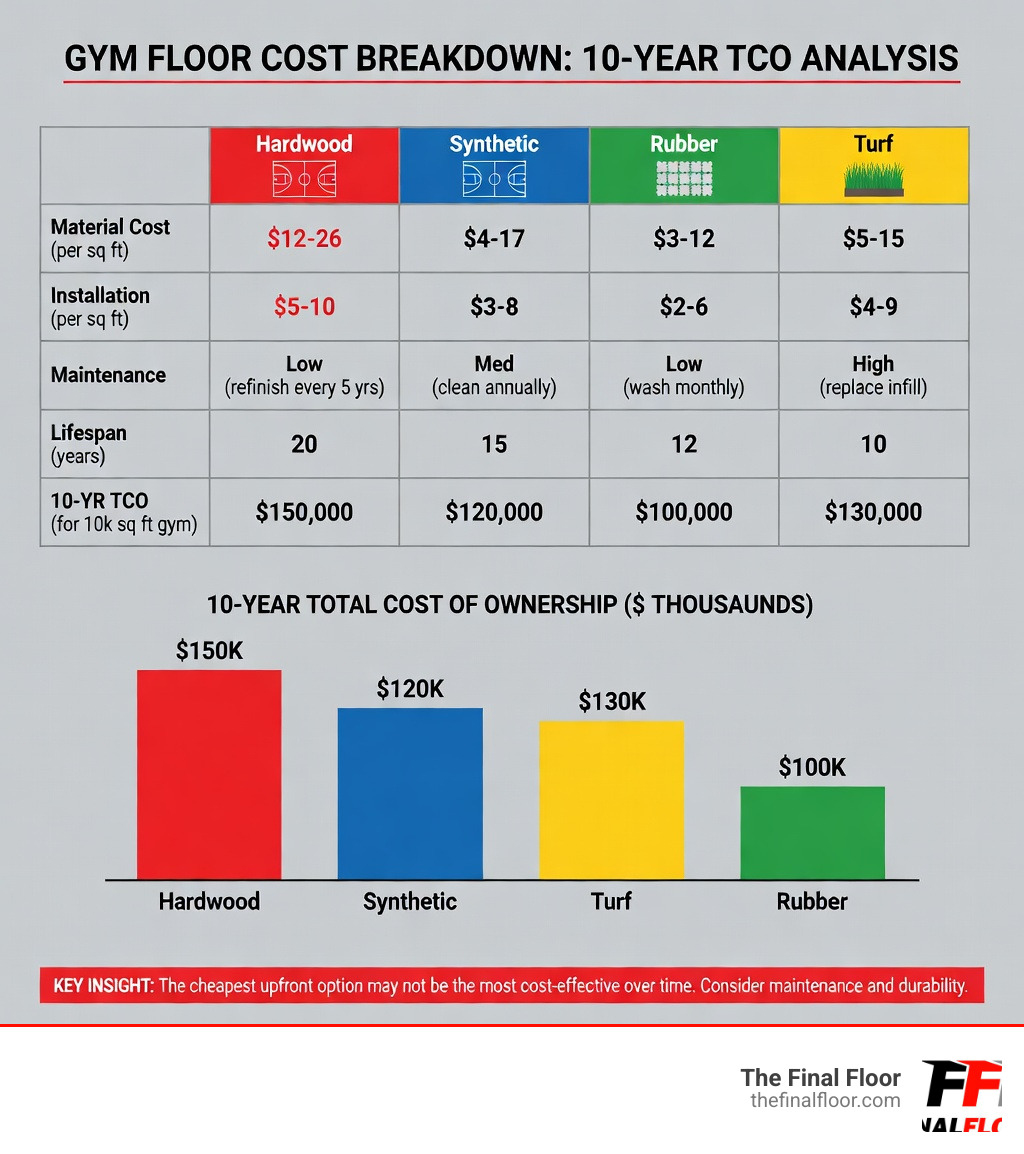
Average Gym Floor Cost per Square Foot by Material
When we look at the “sticker price” of gym flooring, it is easy to get sticker shock. However, we have to look at this as an investment in your facility’s future. The material you choose dictates not only the initial gym floor cost but also how the floor performs under the feet of your athletes.
| Material Type | Material Cost (per sq ft) | Installation Cost (per sq ft) | Lifespan (Years) | Best Use Case |
|---|---|---|---|---|
| Maple Hardwood | $7.50 – $14.00 | $3.50 – $8.00 | 35 – 50 | Basketball/Volleyball |
| Synthetic Rubber | $3.96 – $12.00 | $2.50 – $5.00 | 15 – 20 | Weight Rooms/Training |
| Sports Vinyl | $4.50 – $6.50 | $2.00 – $3.50 | 10 – 15 | Multi-purpose/Yoga |
| Polyurethane | $4.00 – $12.00 | $3.50 – $5.50 | 10 – 15 | Multi-sport/Track |
| Indoor Turf | $3.00 – $8.50 | $1.00 – $4.00 | 8 – 12 | Agility/Sled Drags |
Whether you are outfitting a high school in Columbus, Ohio, or a community center in West Virginia, the material choice is the biggest lever in your budget. For a deeper dive into these options, you can explore the Gym Flooring Category on our site.
Hardwood System Pricing
Hardwood is the “gold standard” for a reason. Specifically, Northern Hard Maple is the undisputed champion for professional-grade athletic facilities. The gym floor cost for hardwood is influenced heavily by the grade of the wood:
- First Grade Maple: This is the cleanest look, with minimal natural character marks. It costs between $11.50 and $14.00 per square foot for materials alone.
- Second Grade Maple: Often considered the “sweet spot” for high schools in Indiana and Kentucky, this grade offers a mix of durability and value, costing $9.50 to $11.00 per square foot.
- Third Grade Maple: The most budget-friendly hardwood, featuring more natural color variations, priced at $7.50 to $9.00 per square foot.
The subfloor system—the layers of rubber pads and wooden sleepers beneath the surface—provides “area-elastic” performance. This means the floor deflects over a wide area when an athlete jumps, reducing the risk of injury.
Synthetic and Rubber Gym Floor Cost
If you aren’t building a basketball court, synthetic surfaces might be your best bet. These are “point-elastic” surfaces, meaning they compress right under the point of impact.
Rolled Rubber is a favorite for commercial gyms because it is durable and seamless. For large areas, rolls are often more economical than tiles, with prices starting around $3.96 per square foot. Vulcanized rubber is a premium version of this, created under high heat and pressure to be non-porous and incredibly tough—ideal for areas with heavy weights or ice skates.
Why does this matter? Scientific research on how sports flooring affects impact forces and performance shows that different floors respond differently based on the shoe cushioning used, meaning the right floor can actually help your athletes perform better and fatigue less quickly.
Factors Influencing Your Total Gym Flooring Investment
It would be nice if we could just multiply the square footage by the material price and call it a day, but gym flooring is a bit more complex. Several variables can shift your gym floor cost by thousands of dollars.
- Facility Size and Layout: Economies of scale apply here. A 10,000-square-foot high school gymnasium in Ohio might secure a better per-square-foot rate than a small 1,000-square-foot studio. However, complex layouts with many corners or pillars increase labor time.
- Subfloor Preparation: This is the most common “hidden cost.” If your concrete slab isn’t level, we may need to use self-leveling compounds or grinding, which can cost $2.00 to $4.00 per square foot.
- Moisture Barriers: In humid regions like West Virginia or near the river in Kentucky, vapor transmission through concrete can ruin a floor. Installing a moisture barrier is a non-negotiable insurance policy for your investment.
To help you steer these choices, we’ve put together a guide on choosing the best gym flooring for your space.
Geographic and Site Conditions
Since we serve Ohio, Indiana, Kentucky, and West Virginia, we know that local labor rates and climate play a huge role. Humidity control is vital; if your facility doesn’t have a consistent HVAC system running, a hardwood floor can warp or buckle. Freight costs also vary based on how close you are to the manufacturing source (like the maple mills in the north).
Customization and Specialized Zones
Do you want your school mascot in the center of the court? Custom graphics and game line painting for a typical high school gym can run between $8,000 and $12,000.
For modern commercial gyms, “zones” are trending. You might have a 3/4-inch rubber section for Olympic lifting and a section of functional training turf for sled work. Scientific research on synthetic turf design and athlete safety highlights how these surfaces have become staples in athletics over the last 50 years, providing a safe environment for high-impact agility training.
Commercial vs. Home Gym Floor Cost Breakdown
The gap between a home garage gym and a professional facility is wide, mostly due to the intensity of use and the need for professional installation.

Budgeting for Commercial Facilities
For a mid-sized commercial facility, you should budget between $46,200 and $198,000 for a complete flooring overhaul. This “all-inclusive” price covers the materials, the skilled labor required for a professional finish, and the necessary accessories like transition strips and wall base.
Commercial gyms benefit from bulk discounts. If you are covering 20,000 square feet, you might see your rubber flooring costs drop to the $5–$7 per square foot range. However, you are also paying for professional-grade durability that can withstand hundreds of people using the space every single day.
Value Engineering for Home Gyms
If you are outfitting a basement in Oxford, Ohio, you can save money by “value engineering.”
- Horse Stall Mats: These are a legendary budget hack. At less than $2.50 per square foot, they offer incredible protection for heavy lifting.
- DIY Installation: Many home gym products, like interlocking foam or rubber tiles, are designed for the homeowner to install in a weekend.
- Sound Dampening: If your gym is on a second floor, investing in a slightly thicker 8mm or 10mm rubber roll can save your ears (and your relationship with your neighbors).
Long-Term Maintenance and Lifetime Value
We often tell our clients: the most expensive floor is the one you have to replace in five years because you didn’t maintain it.
Hardwood Refinishing Costs
Hardwood floors can last 40 to 50 years, but they require a “glow-up” every now and then.
- Annual Screening and Recoating: This costs about $1.50 to $2.50 per square foot and should be done every year to keep the surface grippy and protected.
- Sanding and Refinishing: Every 5 to 10 years, the floor needs to be sanded down to bare wood and completely refinished. This is also the time to update game lines or logos.
For more details on how to keep your floor looking new, check out our page on gym floor refinishing services.
Synthetic Surface Longevity
Synthetic floors like vinyl or polyurethane have a shorter lifespan (10–20 years) but require less intensive daily maintenance. You won’t be sanding them, but you may need to apply a new top-coat or repair seams as they wear down. Interestingly, while the upfront gym floor cost for synthetic is lower, the lifetime cost can be higher because they cannot be refinished as many times as hardwood.
Frequently Asked Questions about Gym Floor Cost
How much does a mid-sized commercial gym floor cost?
For a standard 8,000 to 10,000-square-foot facility, the total project cost usually falls between $46,200 and $198,000. This includes high-quality materials, professional installation, subfloor prep, and finishing. If you choose premium maple, expect to be at the higher end of that range; if you go with rolled rubber or vinyl, you’ll likely be at the lower end.
What is the most cost-effective gym floor cost for home use?
The best value for home use is often rolled rubber or horse stall mats. You can find 8mm rubber rolls for around $3 per square foot. While foam puzzle mats are the cheapest (around $1 per square foot), they aren’t water-resistant and can be dangerously slick when wet, making them a “potential injury nightmare” for serious lifting.
Does flooring thickness affect the total price?
Yes, absolutely. Thickness is directly tied to the volume of material used. For example, a 1/2-inch rubber floor is significantly more expensive than a 3/8-inch floor. However, if you are doing CrossFit or Olympic lifting, that extra thickness is necessary to protect your subfloor from cracking under the impact of heavy weights.
Conclusion
At The Final Floor, we believe that your gym floor is the foundation of your athletic success. Whether you are managing a university arena or a local community center in Ohio, Indiana, Kentucky, or West Virginia, we are here to help you steer the complexities of gym floor cost.
From expert project management to durable athletic systems that stand the test of time, we provide the high-quality solutions your facility needs. Don’t let the numbers overwhelm you—start with a plan and a partner you can trust.
Ready to see what we can do? View our portfolio of athletic flooring projects or contact us today for a free consultation to get a precise estimate for your specific space.